
Blog
Boat Appraisal for Estate Settlement: Establishing Defensible Value for Probate Court
A boat appraisal for estate settlement must reflect fair market value as of the date of death, not replacement cost, an insurance schedule, or a marketplace listing price. This guide walks executors through the federal and state standards, the alternate valuation date election, and what a defensible written report needs to hold up in probate court.
When a boat shows up on an estate inventory, the number attached to it has to satisfy two different audiences at once: the probate court supervising distribution of the estate, and, if the estate is large enough, the IRS. Getting that number wrong isn't a minor paperwork slip. It can delay probate, spark a dispute among heirs, or expose the executor personally if the estate is later reviewed. This guide covers what "value" actually means for an estate boat, what a written appraisal needs to contain, and where executors most often get it wrong.
What Fair Market Value Means for an Estate Boat
Fair market value, not replacement cost, insurance value, or the original purchase price, is the standard that governs a boat included in an estate. The IRS Form 706 instructions define fair market value as the price a boat would sell for between a willing buyer and a willing seller, with neither party under compulsion to buy or sell and both having reasonable knowledge of the relevant facts. A forced or distress sale price does not meet that definition, even when it's the number that actually changes hands.
The valuation date matters as much as the valuation method. The standard date is the decedent's date of death. An estate may elect an alternate valuation date, generally six months later, but that election comes with conditions covered below. Either way, the appraisal has to be a snapshot of the boat's condition and the market as they existed on that specific date, not on the day the appraiser happens to inspect the vessel or the day it eventually sells.
Example: A 38-foot sportfisher owned by the decedent is inspected by an appraiser four months after death. The report states the opinion of value as of the date of death, based on the boat's condition and comparable sales activity around that date, even though the physical inspection happened later. That distinction, valuing the boat "as of" a date rather than "as inspected on" a date, is what makes the report usable for estate purposes.
What a Defensible Boat Appraisal Report Must Include
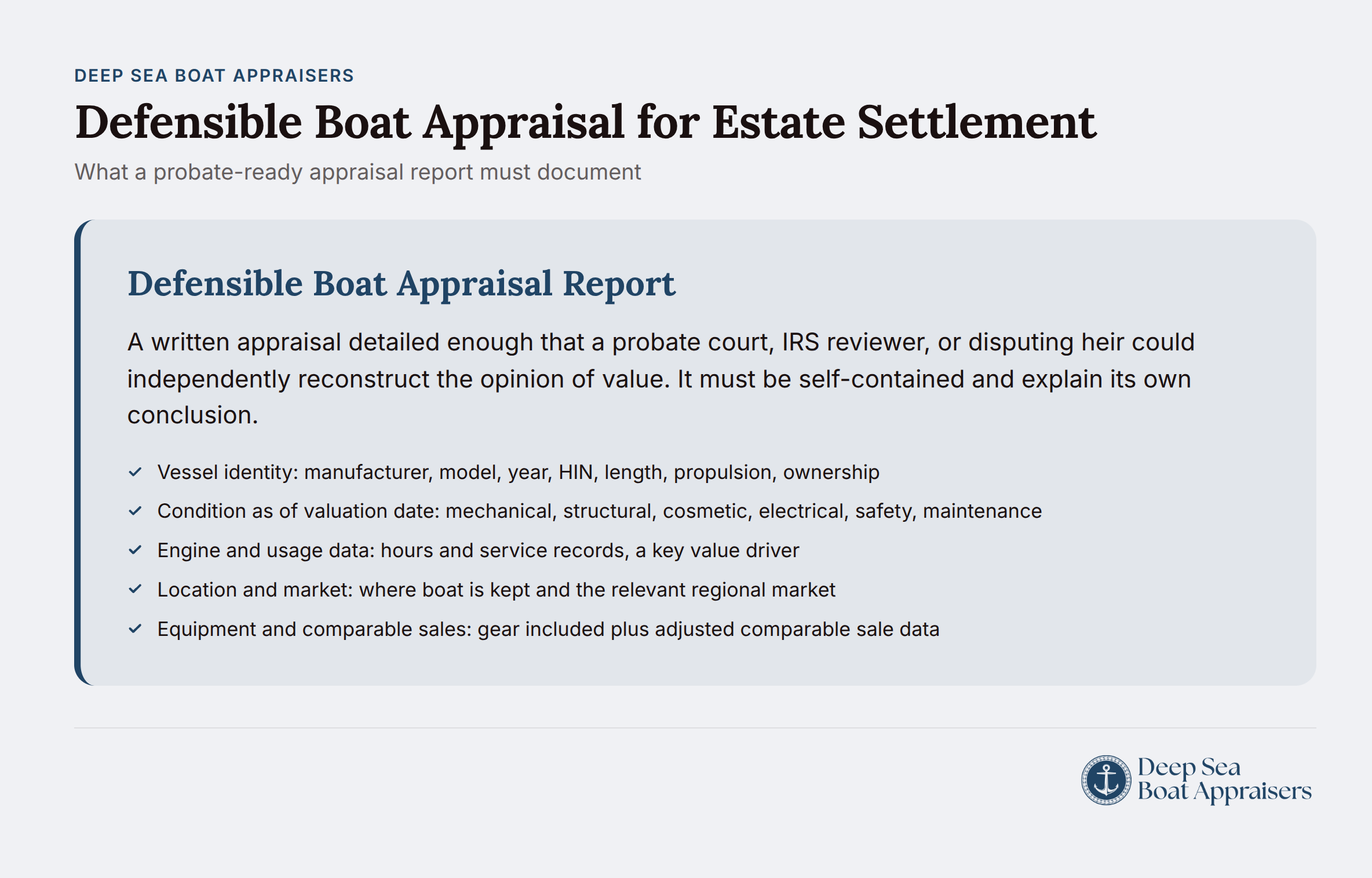
A written appraisal that will hold up with a probate court or the IRS needs to document the boat and the market with enough specificity that a reviewer could reconstruct the opinion of value independently. General industry practice and the same standards our marine appraisal team follows for boat appraisal engagements require a report to establish the following:
- Vessel identity: manufacturer, model, model year, hull identification number, length, propulsion type, and documented ownership.
- Condition as of the valuation date: mechanical, structural, cosmetic, electrical, and safety condition, along with maintenance history where available.
- Engine and usage data: engine hours and service records, since hours logged are one of the strongest drivers of value in a marine survey and directly affect where a comparable-sale adjustment lands. Our guide on how engine hours shape a boat's appraised value walks through why this single data point carries so much weight.
- Location and market: where the boat is moored or stored, and the market in which comparable vessels of that type are typically sold, since a boat's value can shift meaningfully by region.
- Included equipment: engines, trailer, electronics, tenders, generators, and any improvements or separately identifiable personal property aboard.
- Comparable sales and adjustments: closed sales of similar vessels, with clear adjustments for age, hours, condition, equipment, and market timing.
A report missing any of these elements leaves gaps that a probate court, an IRS reviewer, or a disputing heir can exploit. The goal is a self-contained document that explains its own conclusion.
Does the Estate Need to File IRS Form 706?
A federal estate tax return is only required when the gross estate exceeds the federal exemption threshold, which the IRS adjusts annually. That threshold is set high enough that most estates never file a return at all, and the IRS's estate tax FAQ page is the place to confirm the current figure rather than relying on a number that will go stale year over year.
When a Form 706 filing is required, a decedent's boat is generally reported as tangible personal property, most commonly on Schedule F, at its fair market value on the valuation date. But the absence of a federal filing requirement does not mean the boat's value is irrelevant. It still has to be established for probate purposes, for dividing the estate among heirs, and for setting the heirs' cost basis in the boat going forward.
State Probate Courts Can Require an Appraisal Regardless of Federal Filing
Federal estate tax rules do not set one nationwide probate threshold or a single universal rule requiring a professional appraisal of every boat. Probate administration, including inventory requirements, small-estate procedures, and any requirement for a court-appointed appraiser or referee, is governed by the law of the state administering the estate, and those rules vary significantly from state to state.
That means an estate with no federal filing obligation can still be required by a probate court to submit a documented, date-of-death value for the boat before it can be sold, distributed, or divided among beneficiaries. Executors should confirm the inventory and valuation rules in the decedent's state of domicile early, since those rules, not the federal exemption amount, often drive whether a formal appraisal is required at all.
Key takeaway: A federal exemption threshold high enough to excuse most estates from filing Form 706 does not excuse the executor from establishing a defensible value for the boat under state probate law.
The Alternate Valuation Date and Assets Sold During the Six-Month Window
An executor may elect to value estate property, including a boat, on an alternate valuation date generally set six months after death rather than on the date of death itself. The IRS guidance on Form 706 makes this election subject to specific statutory conditions, and once made, it must be applied consistently across the estate's qualifying property rather than cherry-picked asset by asset.
The election matters most when a boat is sold or distributed to a beneficiary within that six-month window. In that case, the value used is typically the value on the date of the sale or distribution rather than the value six months out. That interaction is easy to get wrong, and it is one of the more common reasons an estate's reported values end up inconsistent with what actually happened to the asset.
Pro tip: If the family plans to sell the boat quickly after death rather than keep it, flag that intention to the estate's attorney or CPA before electing the alternate valuation date. The timing of a sale can determine which valuation date actually controls.
What Does Not Hold Up as Estate Evidence
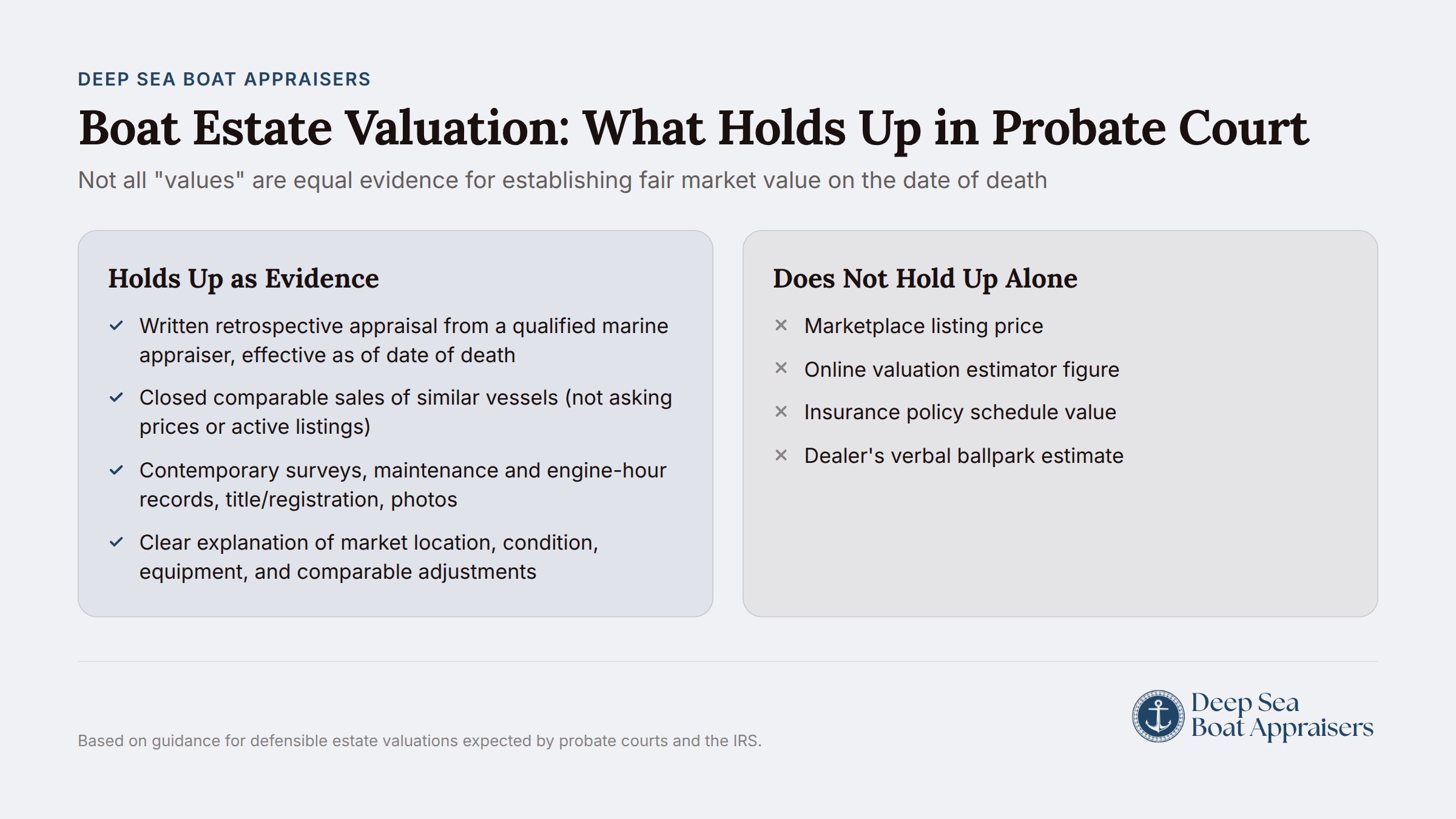
A number pulled from a marketplace listing, an online valuation estimator, or an insurance policy schedule is not the same thing as fair market value on a specific valuation date, and reviewers treat them differently. Our article comparing a boat value estimator against a professional appraisal covers why an instant online number is built for a different purpose and skips the adjustments a defensible estate valuation requires.
The strongest evidence for an estate file, in order of weight, generally looks like this:
- A written retrospective appraisal from a qualified marine appraiser, effective as of the date of death.
- Closed comparable sales of similar vessels, not asking prices or active listings.
- Contemporary documentation: surveys, maintenance and engine-hour records, title or registration records, and photographs from around the valuation date.
- A clear explanation of market location, condition, equipment, and every adjustment made to the comparables.
An asking price on a brokerage listing, a dealer's verbal ballpark, or the number on an insurance schedule can all be useful starting points for an appraiser to research, but none of them, standing alone, documents the analysis a probate court or the IRS expects to see behind a reported value.
Executor Liability: Why the Number You Use Matters
An executor has a fiduciary duty to the estate and its beneficiaries, and that duty extends to how assets are valued, not just how they are distributed. If an estate is later reviewed and the boat's reported value turns out to be unsupported, the exposure runs in two directions.
On the tax side, an unsupported value on a filed Form 706 can be challenged, potentially changing the estate's tax liability and the basis heirs use when they eventually sell the boat, an issue discussed in the context of basis-consistency requirements for inherited property. On the probate side, a beneficiary who believes the boat was undervalued, or overvalued, in a way that skewed their share of the estate can dispute the inventory in court. A written appraisal from a qualified appraiser, whose role in probate matters is well established in professional practice, gives the executor a documented, third-party basis for the number, which is a meaningfully stronger position than a verbal estimate or a listing price the executor found online.
Watch out: Using a friend's guess, a dealer's quick verbal number, or last year's insurance value to fill in a probate inventory is one of the most common ways executors expose themselves to a later dispute. If the boat has any meaningful value, get it in writing from a qualified appraiser.
How This Appraisal Differs From a Donation or Insurance Appraisal
An estate settlement appraisal, a charitable donation appraisal, and an insurance appraisal all produce a dollar figure for the same boat, but they are not interchangeable. A donation appraisal values the boat as of the gift date under IRS charitable contribution rules, built around a different reporting form and different documentation standards. An insurance appraisal typically establishes an agreed or replacement value for coverage purposes, which by design is not the same figure as fair market value on the open market. Our breakdown of agreed value versus replacement cost in a boat insurance appraisal covers that distinction in more depth.
An estate appraisal, by contrast, has to answer to fair market value standards on a specific valuation date and needs to satisfy both a probate court's inventory requirements and, when applicable, the IRS's estate tax rules. Handing a probate court an insurance schedule value, or handing the IRS a donation appraisal from a different tax year, is a mismatch that can require redoing the work.
If you're settling an estate that includes a boat, request an appraisal from our marine appraisal team and we'll scope a report built for the standard your probate court or the IRS actually requires.
This article is provided for general informational purposes only and does not constitute legal, tax, or financial advice. Readers should consult a qualified attorney or CPA regarding their specific circumstances.